

On Thursday, January 29, a High-Level Tripartite Roundtable on Social Dialogue and Labor Dispute Resolution began in Astana, organized by the International Labour Organization (ILO) as part of the implementation of the Roadmap for Promoting Decent Work in the Republic of Kazakhstan.
The event was attended by representatives of the Federation of Trade Unions of Kazakhstan, the Ministry of Labor and Social Protection of the Population of the Republic of Kazakhstan, the National Confederation of Employers of the Republic of Kazakhstan “PARYZ,” the ILO, and the UN Programme in Kazakhstan.
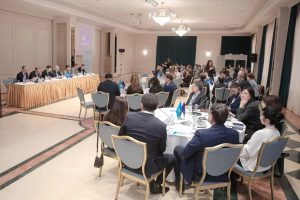
The event served as a platform for discussing key directions in developing social partnership, strengthening the trade union institution, and ensuring decent working conditions for all workers in the country.
Meirambek Akhmetov, Chairman of the Committee of State Labor Inspection of the Ministry of Labor and Social Protection of the Population, highlighted the strategic importance of cooperation with the ILO.
“During more than 30 years of cooperation, Kazakhstan has ratified 26 key ILO conventions covering labor safety, equal opportunities, and youth employment. This is the result of systematic work and our commitment to the principles of decent work,” emphasized Meirambek Akhmetov.
He explained that the implementation of the Roadmap for Promoting Decent Work is built around five main areas.
“Safe labor and compliance with workplace standards through labor inspections, development of social dialogue and freedom of association, minimum wage, social protection and security, elimination of violence and harassment—these are the areas we actively work on with international partners,” said the Committee Chairman.
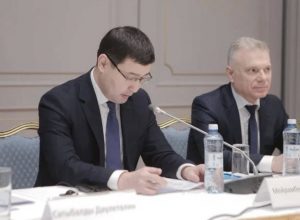
Meirambek Akhmetov emphasized the role of trade unions in supporting workers.
“Today, trade unions unite more than 2.5 million workers and are a key institution for reconciling interests. We are interested in strong, responsible trade unions capable of effectively protecting workers’ rights. Tripartism and social dialogue remain the most important principles of joint work between the government and social partners,” he stressed.
In his welcoming address, Chairman of the Federation of Trade Unions of the Republic of Kazakhstan (FPRK) Satybaldy Dauletalin highlighted the importance of social dialogue and the role of trade unions in protecting workers’ rights.
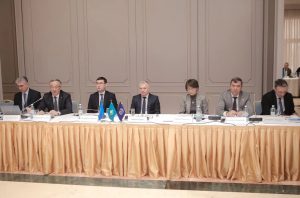
“We are gathered here for the people. For those who go to work in the morning, who operate machines in factories, who ensure production and the country’s economy. For those who every day support society with their labor. If these people do not have confidence in the future, no reforms or laws will be sustainable. That is why social dialogue is not just formal meetings on a schedule. It is a living, real process where workers must be heard, and the state and employers must understand their duties and responsibilities,” said the FPRK Chairman.
Satybaldy Dauletalin stressed that the Federation of Trade Unions actively participates in all key processes.
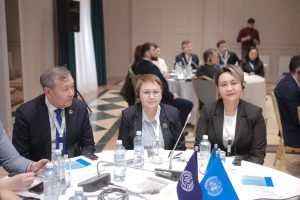
“We help improve labor legislation, strengthen tripartism, and develop collective bargaining, including on freedom of association, peaceful resolution of labor disputes, and conflict prevention. But there are systemic challenges that cannot be solved by piecemeal amendments. We need a unified professional approach and shared responsibility of all social partnership parties,” he noted.
Discussing concrete results of trade union work, Dauletalin noted that, thanks to joint work by social partners, the number of collective labor disputes is decreasing.
“Today we see real results. Almost 80% of collective labor disputes are resolved peacefully during negotiations. This saves resources, preserves jobs, and strengthens workers’ trust in their organizations. It is important for us that labor disputes are resolved peacefully and in advance. Reconciliation, mediation, and arbitration should become the norm, not a rare exception. This preserves jobs, saves resources, and strengthens trust in society. Today we see a decrease in labor conflicts in organizations with active trade unions, and this is the result of the joint work of all participants,” emphasized Satybaldy Dauletalin.
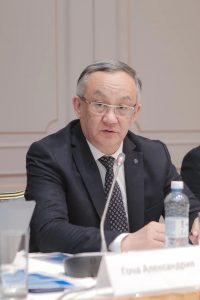
The FTURK Chairman also addressed wage issues, highlighting their importance for social justice.
“The minimum wage is not just a number. It is a basic guarantee of decent work and social justice. It shows that the state respects the labor of its citizens and cares about their safety and well-being. Last week, the Federation of Trade Unions of Kazakhstan sent a letter to the Prime Minister with concrete proposals for implementing ILO Convention No. 131. Our initiatives concern improving the methodology for calculating the minimum wage. We conducted a major comparative analysis. According to our data, the current methodology complies with the convention only by 60%. We propose that the minimum wage reach 50% of the median salary over the next five years,” emphasized the trade union leader.
Satybaldy Dauletalin noted that minimum wage issues are directly related to people’s lives.
“Rising prices and high inflation are most felt by those living paycheck to paycheck. This is not theory, but reality: people ask—will there be enough money for food, utilities, children’s clothing, or medicine for parents? For us, social justice is not a slogan but concrete measures that genuinely protect people. The average nominal salary in Kazakhstan rose by 10% over the year, but with high inflation, real incomes fell by 10%. Such a decline has not been seen in the past 25 years. This is alarming. If we want sustainable development, we must respond to real problems,” said the FTURK Chairman.
Dauletalin stressed that the social partnership system must be sustainable and balanced.
“For us, the issue of decent work is the main issue. We are creating a system where social partners negotiate in advance, honestly, and on equal terms. Workers must be heard, employers must understand their duties, and government decisions must work in real life. Without this, social partnership becomes a mere label. International standards and ILO conventions are our guide. Today, together with social partners, the ILO, and the UN system, we are forming a national program for decent work. It must serve the working person and not remain a declaration. Only joint actions by the state, employers, and trade unions will ensure sustainable growth, social justice, and protection of workers’ interests across the country. We are confident that the results of today’s work will form a solid foundation for practical implementation of the Roadmap, strengthening social dialogue, and achieving sustainable development goals,” added the FTURK Chairman.
In turn, Chairman of the Presidium of the National Confederation of Employers of the Republic of Kazakhstan “PARYZ,” Zhumabek Zhanykulov, emphasized the importance of social dialogue for sustainable economic and social development.
“Our meeting is about how social dialogue should become a durable development tool, not a theater. For us, dialogue is a means of creation, not a formal process. We view ILO conventions not as a declaration but as practical guidance for Kazakhstan. In social partnership, we listen to each other, meet, discuss issues, and aim for proper legislative implementation,” explained Zhanykulov. He also emphasized balancing the interests of business and workers, particularly regarding the minimum wage.
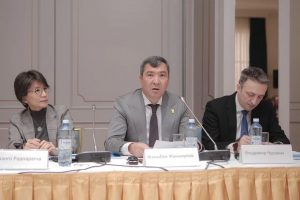
“The minimum wage is a guarantee of fairness and decent work. But business must be economically efficient. Entrepreneurs must earn money and pay taxes, from which the state fulfills its social obligations. Without sustainable business, no social programs can work. State decisions on exchange rates or tax policy directly affect business capabilities. If the economic security of entrepreneurs is ignored, no wage or social benefit increase will be effective,” said Zhanykulov.
UN Resident Coordinator in Kazakhstan, Sarango Radnaragcha, emphasized the importance of social dialogue and tripartite cooperation for the country’s sustainable development.
“Today’s meeting reflects the joint commitment of the government of Kazakhstan, employers, worker representatives, and the UN system to the principles of decent work, fairness, and inclusivity. As we all know, social or tripartite dialogue is a cornerstone of our vision. It is a platform where the voices of workers, employers, and government are heard, differences discussed constructively, and consensus reached. This dialogue is also deeply rooted in fundamental human rights, including freedom of association and collective expression,” noted Sarango Radnaragcha.
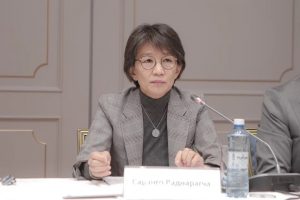
The UN Coordinator highlighted that Kazakhstan continues efforts to harmonize national labor policy with international standards, and the Roadmap for Promoting Decent Work provides an additional guide for sustainable development.
“We welcome the adoption of the General Agreement between the government, national employer associations, and trade unions. I am pleased to note that it also refers to the UN Sustainable Development Goals, which is particularly important given that only five years remain until 2030,” said the UN Resident Coordinator in Kazakhstan.
Radnaragcha also noted new UN framework cooperation programs and their practical focus.
“The UN in Kazakhstan has signed a new five-year framework cooperation program with the government for 2026–2030. In a rapidly changing economy, with technological transformation and global uncertainty, dialogue and cooperation must remain dynamic and sustainable,” she said.
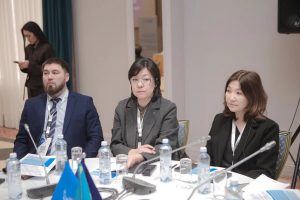
According to an international expert, priority areas of cooperation will include improving the quality of public services, economic diversification and promotion of decent work, climate adaptation measures, and strengthening social cohesion.
Mikhail Pushkin, Director of the ILO Technical Team on Decent Work and Representation in Eastern Europe and Central Asia, noted the importance of a systematic approach to social dialogue and compliance with international labor standards.
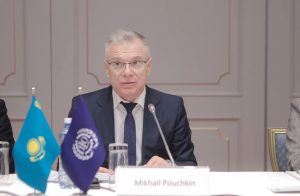
The speaker emphasized the importance of practical application of international conventions, such as ILO Conventions No. 87, 98, and 198:
“First, it is necessary to strengthen social dialogue at all levels—national, regional, and sectoral. Social dialogue includes consultations, information exchange, and joint discussion of new policy initiatives. Second, observing the principles of freedom of association and protection of workers’ rights is key,” stressed Mikhail Pushkin.
He noted that Kazakhstan demonstrates successful application of these principles, particularly through the development of institutional capacity and trade unions.
“We see the fruits of joint work, especially in labor inspection. With ILO support and Kazakhstan’s active stance, we have strengthened freedom of association and workers’ ability to protect their rights. Unlike other countries in the region, we have a constructive and mature system of interaction between trade unions and employers,” emphasized Pushkin.
During the meeting, special attention was given to a presentation of ILO principles on social dialogue and collective bargaining prepared by ILO specialist Carlos Garcia. The international expert explained the key provisions of Conventions No. 87, 98, and 154, highlighting their relevance to Kazakhstan.
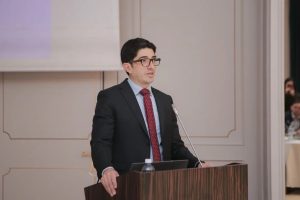
At the Plenary Session on freedom of association, Deputy Chairwoman of the Federation of Trade Unions of Kazakhstan, Gulnara Zhumageldieva, presented on trade union freedom according to ILO standards.
“For Kazakhstan, a country undergoing institutional and socio-economic reforms, strengthening freedom of association has strategic importance. It directly affects trust in state institutions, investment climate, and the country’s international image. By ratifying ILO Convention No. 87, Kazakhstan committed not just to formal recognition of freedom of association, but to prevent regression in this area and consistently align national legislation and enforcement with international standards,” noted Zhumageldieva.
The Deputy Chairwoman emphasized the relevance of this issue amid digitalization, economic transformation, and labor market changes, noting that trade unions remain the legal and institutional mechanism for protecting workers’ interests. She expressed concern over proposed amendments to the Labor Code and Law “On Trade Unions,” which, according to FPRK, could significantly restrict workers’ rights and threaten social stability.
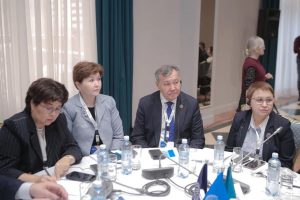
“These norms complicate the exercise of collective action rights, introduce excessive procedural barriers, and create conditions for administrative interference in trade union activities. For example, stricter requirements are proposed for local unions, limiting their representation scope, increasing administrative control via annual document submission, eliminating the possibility of establishing sectoral unions in small businesses, and turning the unions’ right to protect members into an obligation,” emphasized Gulnara Zhumageldieva.
She noted that such measures contradict the Constitution, international standards, and practices of other countries.
“According to ILO Convention No. 87, workers have the right to form organizations without prior authorization and join them under their statutes. The state should not interfere, and workers’ organizations cannot be dissolved or banned administratively. Amendments requiring annual submission of documents create hidden administrative control and risk of union deregistration on formal grounds,” explained Zhumageldieva.
Furthermore, she highlighted positive achievements of Kazakhstan, noting that the country has been removed from the “short list” of Convention No. 87 violators, ratified Convention No. 131 on minimum wage, restored FPRK membership in the International Trade Union Confederation, and its chairman holds leadership positions in international structures, including the Pan-European Regional Council of ITUC.
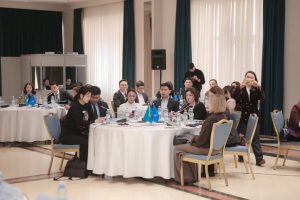
On the first day of the roundtable, a plenary session also focused on regulation of employer organization representativeness criteria. Participants exchanged views, discussed approaches to improving social partnership legislation, and outlined priority areas for further work.
The roundtable will continue on January 30. On the second day, participants will focus on practical aspects of peaceful labor dispute resolution mechanisms. At the end of the second day, recommendations will be summarized and a final document with key proposals for developing Kazakhstan’s national collective labor dispute resolution system will be prepared.
FTURK Trade Union Communications Center
ITUC PERC members develop approaches to AI regulation and the protection of workers’ human rights