

On Friday, January 30, the international conference of the Pan-European Regional Council (PERC) of the International Trade Union Confederation (ITUC) continued its work under the theme “The Introduction of AI in Workplaces in PERC Countries and Trade Union Responses.”

The conference has been held online since January 29 and is aimed at facilitating a systematic exchange of experience among national trade union centers, international organizations, and experts on the impact of artificial intelligence on labor, employment, and workers’ social guarantees.
In this context, special attention is paid to issues of legal regulation, social responsibility, and the role of trade unions in shaping a balanced approach to the use of AI.
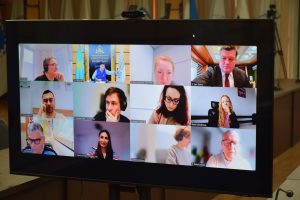
Welcoming the participants, PERC President Igor Zubcu emphasized the importance of the event for PERC countries, as digitalization processes and the introduction of algorithmic labor management systems are already having a direct impact on working conditions, employers’ decision-making mechanisms, and the realization of workers’ labor and socio-economic rights.

“Our main goal is the democratization of artificial intelligence. We must ‘make friends’ with these technologies as quickly as possible. Innovation should serve us, not control us,” Igor Zubcu stressed.
Within the conference agenda, Michael Watt, economist at the International Labour Organization’s Bureau for Workers’ Activities (ACTRAV) and Evaluation Coordinator, presented an overview of the AI and Digital Economy Observatory.
The ILO expert focused on certain aspects of the impact of digital technologies on the labor market and emphasized the need to take workers’ perspectives into account when developing national and international regulatory approaches.
According to the international expert, AI will not lead to the disappearance of work as such but may only transform certain tasks.
“Digital technologies do not necessarily lead to the automation of an entire profession. They usually automate individual tasks. If your job is to write standard code, you can be easily replaced. But if you use LLM models to increase productivity, this will in no way destroy your job. We are talking about technological innovation and technical progress — all of this is developing very rapidly. We tend to make linear forecasts. But when it comes to what will happen to our jobs if robots are everywhere, this is something we have observed over the past 200 years. We will not see a destructive impact on jobs,” the speaker noted.
According to him, AI will primarily transform the work of mid-level professionals — lawyers and administrators — by automating cognitive tasks such as text analysis and report preparation.
The expert emphasized that automation is often constrained by the high cost of implementation compared to human labor, which gives trade unions time to prepare and retrain workers.
“If something is technologically possible, it does not necessarily mean that it is economically justified. The cost of automation often exceeds labor costs. Sometimes industrial revolutions do not necessarily have a macroeconomic impact that destroys jobs. We see accompanying painful transition periods for certain groups of workers, rather than mass unemployment,” Michael Watt said.
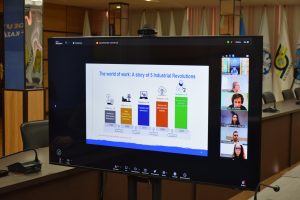
As the speaker reported, the ILO has launched a two-year period for 2026–2027 this year.
“For the first time, the ILO budget includes a separate line for digitalization. We have a database — the Observatory. There you can see legislative details: which platforms are covered, when the law was adopted, provisions on social protection or algorithmic management. This is a tool that helps truly understand what collective agreements are about,” the speaker explained.
He clearly demonstrated national laws and examples of collective agreements protecting the rights of platform workers, which are accumulated in the Observatory.
A separate part of the discussion was devoted to the practices of national trade unions in including issues of digitalization, algorithmic management, and the protection of workers’ data in collective bargaining and agreements.

Kazakhstan’s experience in the implementation of artificial intelligence and its legislative regulation was presented by Nurlan Uteshev, Deputy Chairman of the Federation of Trade Unions of the Republic of Kazakhstan (FTURK).
In his report, he focused on the fundamental change in the role of the digital environment in the modern social and economic system.
“Today, digital space has ceased to be exclusively a technological sphere. It has effectively become one of the key environments for the realization of human rights, economic freedoms, and social relations,” Nurlan Uteshev emphasized.
The speaker noted that the international community is consistently recording the growth of risks associated with the impact of technologies on fundamental labor rights. According to him, the uncontrolled use of algorithms poses a threat to individual autonomy.
“We are witnessing how automated and algorithmic decisions can entrench discrimination, influence a person’s economic opportunities, shape behavioral patterns, and set agendas without the individual’s participation,” the Deputy Chairman of FTURK noted.

Nurlan Uteshev paid special attention to the issue of digital identity, warning of a serious danger when increased data collection leads to a real person being replaced by their digital profile.
“There is a risk that a person will be identified with their digital footprint, and decisions about them will be made based on algorithmic interpretations rather than their own will. Both international and national agendas objectively require the formation of a new type of digital legislation focused on the individual. This need has become the conceptual foundation of the Digital Code of the Republic of Kazakhstan,” he stressed.
He explained the logic of the new Code, which builds regulation through the prism of digital humanism, implying the full subordination of technology to the interests of the individual.
“The key provision of the Code is that human rights, freedoms, and legitimate interests are recognized as the highest value in the digital environment. This is not a declaration, but a methodological foundation that determines the internal logic of all regulation,” he explained.

The central element of this approach, according to the Deputy Chairman of FTURK, is the principle of free and informed expression of will.
“No technological tool can replace human will or substitute it with a mechanical action. A legally significant decision requires a volitional act, not an automatic confirmation. The Code protects citizens from the substitution of their will by a click, push notification, or SMS code,” Nurlan Uteshev emphasized.
Speaking about the protection of workers’ rights, he addressed issues of algorithmic management, which is increasingly used in recruitment, labor control, and reliability assessment. In response to these risks, the Code introduces a set of rights, including the right to be informed about the use of an algorithm, the right to an explanation of a decision, the right to review a fully automated decision, and protection against algorithmic discrimination.
Nurlan Uteshev emphasized a protective provision that excludes the deterioration of a worker’s position.
“An algorithmic decision cannot worsen a person’s position compared to a situation in which the decision would be made by a human,” the Deputy Chairman of FTURK stated.

He also presented the concept of a “human digital space,” which integrates data and documents into a personal digital asset under the control of the citizen.
“Control over one’s digital footprint means control over how digital systems interpret a person. In the future, the digital space will allow individuals to grant and revoke access, manage documents, and confirm acts of will,” Nurlan Uteshev concluded.
According to the Deputy Chairman of FTURK, the provisions of the Digital Code project create a solid legal foundation for protecting working people in the digital economy, ensuring a balance between technological development and human dignity.
During the discussion, participants noted that the protection of workers’ human rights in the digital environment is a necessary condition for social development, and that the participation of trade unions in this process is a key element in forming a responsible and balanced approach to the implementation of artificial intelligence.

At the conclusion of the conference, participants emphasized that the experience presented during the sessions would serve as a basis for further study and the development of a consolidated position of ITUC PERC.
Trade Union Communications Center of FTURK