

On Monday, April 27, a delegation of the Federation of Trade Unions of the Republic of Kazakhstan, led by its Chairman Satybaldy Dauletalin, took part in the IX meeting of the Council of Trade Unions of Central Asian Countries (CTUCAC) in Tashkent. The meeting was also attended by heads of national trade union centers of Kyrgyzstan, Mongolia, Tajikistan, and Uzbekistan, as well as the Head of the Europe and Central Asia Department of ILO ACTRAV, Sergejus Glovackas.
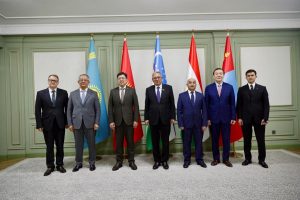
Opening the meeting, the Chairman of the Federation of Trade Unions of Uzbekistan, Kudratilla Rafiqov, emphasized its historic significance.
“The Council has proven its viability and has become a center for developing coordinated decisions. But today we are approaching a point where the accumulated experience requires a new institutional format. We are moving from a dialogue platform to a structure capable of ensuring binding decisions and real impact. We have established a stable practice of cooperation and gained recognition from the International Labour Organization and the international trade union community. This means we have not only potential, but also responsibility,” he emphasized.
According to the agenda, participants exchanged experiences in social dialogue across the member countries. Mahmuddjon Isaev, Head of the Department for the Protection of Socio-Economic Interests of Workers of the Federation of Trade Unions of Uzbekistan, highlighted the experience of co-chairing by social partners in the national tripartite commission. Ismail Fayzizoda, First Deputy Chairman of the Confederation of Independent Trade Unions of Tajikistan, spoke about the creation of a unified database of collective agreements in his country. Bakhtygul Dautalieva, Chief Specialist of the Department of International Cooperation and Protocol of the Federation of Trade Unions of Kyrgyzstan, presented digital projects in the field of social partnership.
An overview of Kazakhstan’s social partnership model was presented by Kairat Aibossynov, Advisor to the Chairman of the Federation of Trade Unions of the Republic of Kazakhstan.
“Today, more than 80% of trade union initiatives are reflected in the General Agreement. Collective agreements cover over 98% of enterprises. This indicates a high level of institutional trust and maturity of social dialogue. In fact, a collective agreement serves as a ‘mini-constitution of an enterprise,’ setting standards of social justice at the level of a specific organization,” he noted.
Commenting on the presentations, Chairman of the Federation of Trade Unions of Kazakhstan Satybaldy Dauletalin outlined the strategic position of the national trade union center.
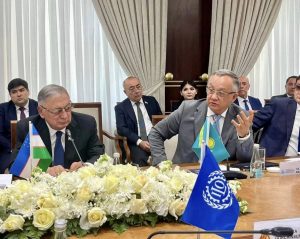
“If we want real influence, decisions must become binding. A separate law on social partnership is needed to ensure systemic regulation, define responsibilities of the parties, and create a sustainable architecture of interaction. Our task is to expand participation in shaping the entire wage system, including sectoral and corporate mechanisms. ILO Convention No. 131, ratified in Kazakhstan at the end of last year, enshrines the principle of social justice—taking into account the needs of workers and their families. This is the benchmark we must follow in improving national methodologies,” he stated.
On digitalization, the Chairman stressed the importance of incorporating standards for the protection of workers’ rights in the era of artificial intelligence—adopted at the previous CTUCAC meeting—into collective agreements.
“We approved standards on protecting workers’ rights in the use of artificial intelligence at the Council meeting in Bishkek. Active work is now underway to integrate these standards into collective agreements. It is important that all of us work on this direction simultaneously, as it is of fundamental importance. Artificial intelligence is developing rapidly, and there is a risk of missing these processes. Therefore, we must prepare in advance—that is precisely why these standards were developed and adopted. Notably, the Council of Trade Unions of Central Asia was among the first to do so. To my knowledge, even at the level of international trade union organizations, such standards are still under development and discussion. If we succeed in embedding these norms into collective agreements, it will be a significant achievement,” said Satybaldy Dauletalin.
Among other key topics of regional cooperation, participants discussed psychosocial working conditions, transformation of occupational safety approaches, and platform employment. Representatives of national trade union centers of Kazakhstan, Uzbekistan, and Tajikistan shared their views on the role of trade unions in creating favorable psychosocial working environments. Nodira Gaibnazarova, Head of the Occupational Safety Department of the Federation of Trade Unions of Uzbekistan, emphasized that the main method for addressing these issues is the development of social partnership at the local level.
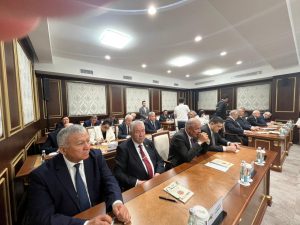
Nurlybek Zhumash, Head of the Administration of the Federation of Trade Unions of Kazakhstan, highlighted the importance of awareness-raising in labor collectives and scaling up educational programs for both workers and employers.
The main highlight of the meeting was the issue of transforming CTUCAC into the Confederation of Trade Unions of Central Asian Countries. Kudratilla Rafiqov noted that in a period of geopolitical instability, unity among the brotherly peoples of Central Asia is of particular importance and presented a draft resolution on the transformation.
“In order to enhance the status and strengthen the role of the Council of Trade Unions of Central Asian Countries in the international arena and in the trade union movement, as well as to improve its effectiveness, the General Assembly resolves:
To transform the Council of Trade Unions of Central Asian Countries into the Confederation of Trade Unions of Central Asian Countries.
To approve the Charter of the Confederation.
To establish that the Confederation is the legal successor of the Council,” he stated.
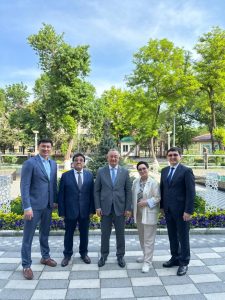
Reflecting on the five-year history of the Council, Satybaldy Dauletalin emphasized that the regional trade union association must move to a new qualitative level.
“The Council was an important stage—a platform for dialogue. The Confederation, however, is an instrument of real influence. This is not just a change of name, but a transition to a new level of responsibility and opportunity. It will strengthen the region’s voice, form a unified agenda, develop common standards, and act as a single entity on the international stage. It will also ensure more effective protection of workers, especially in the context of growing labor migration. History shows that united trade unions become a real force, while fragmented ones lose influence,” he stressed.
The decision to transform CTUCAC into the Confederation was adopted unanimously.
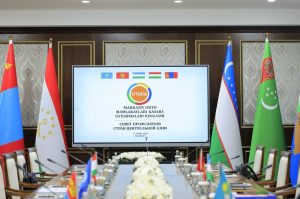
Outlining the Confederation’s tasks, Dauletalin emphasized the need for a compact and professional structure, protection of labor migrants, development of a regional agenda, preparation of annual analytical reports, active participation in international dialogue, and training of young trade union leaders. He also highlighted the importance of preserving institutional memory.
Sergejus Glovackas noted that the International Labour Organization would continue cooperation with the new Confederation, providing support and responding to its initiatives.
During the meeting, Kudratilla Rafiqov was unanimously elected Secretary-General of the Confederation. From Kazakhstan, Satybaldy Dauletalin and Deputy Chairpersons Birzhan Nurymbetov and Gulnara Zhumageldiyeva were elected to the General Council. In total, 15 representatives from member countries joined the Council. Participants also approved the Charter and the composition of the Executive Committee.
The program concluded with a friendly football tournament among the trade union teams of member countries. The team of the Federation of Trade Unions of Kazakhstan took an honorable second place, losing to Uzbekistan in a penalty shootout (6:7).
Trade Union Communications Center of the FTURK