
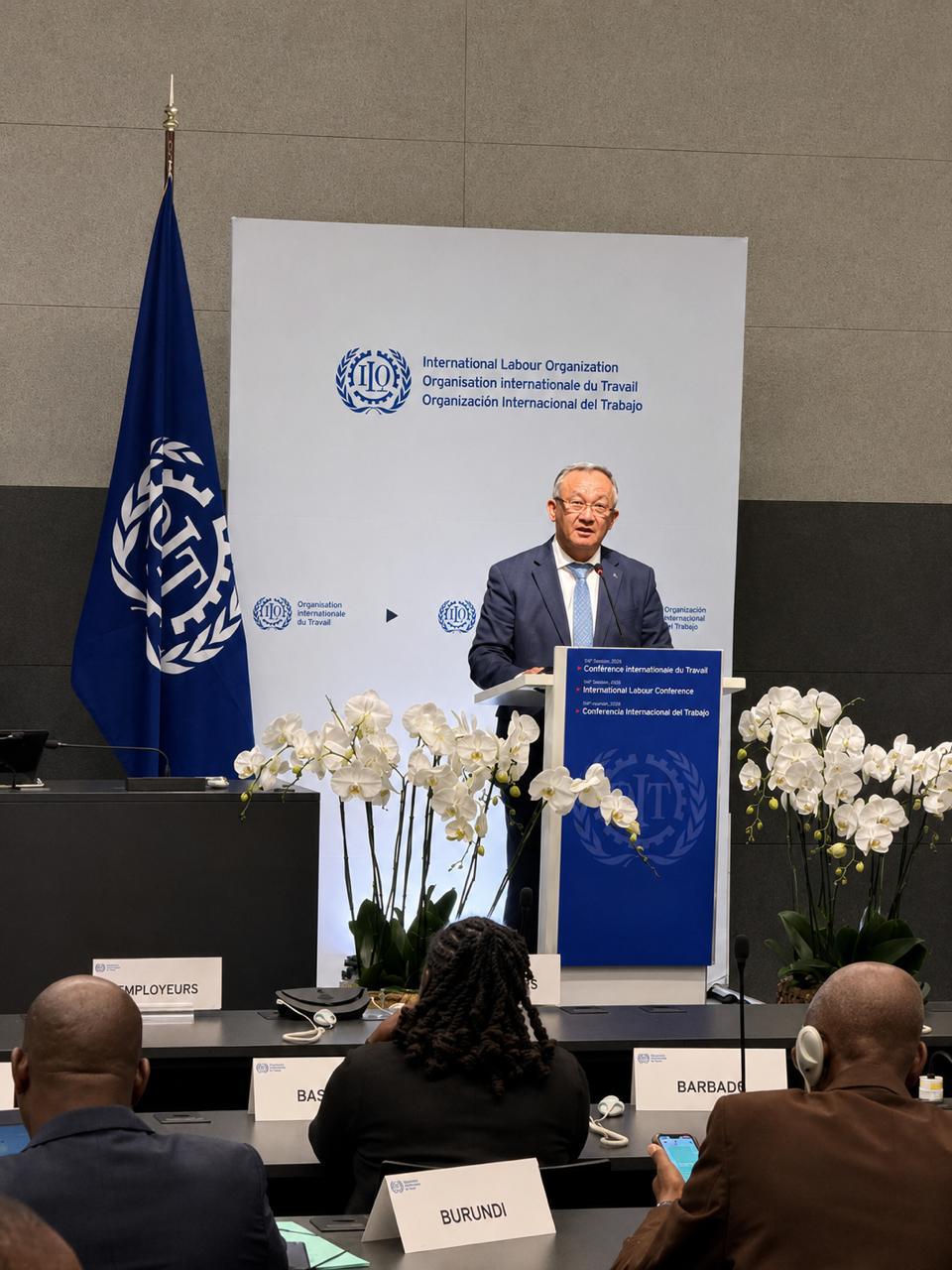
On 1 June, the 114th Session of the International Labour Conference (ILC) of the International Labour Organization (ILO) commenced in Geneva. Traditionally, the Conference serves as one of the world's key platforms for discussing the future of work.
Representatives of governments, employers and workers from the ILO’s 187 Member States are participating in the forum. The delegation of the Federation of Trade Unions of the Republic of Kazakhstan (FTURK), headed by its Chairman Satybaldy Dauletalin, is taking an active part in the discussions shaping the contours of the global labour market for the years ahead.
Particular attention on the opening day was given to the report of ILO Director-General Gilbert F. Houngbo, “A Moment of Choice: Harnessing Artificial Intelligence for Decent Work.” The report highlights that artificial intelligence is becoming one of the key drivers of labour market transformation, creating new opportunities to improve productivity and enterprise development while also raising concerns about the future of employment and workers’ social protection.
“Technological progress is not an unstoppable force. What matters are political choices, institutions and governance. By bringing together governments, employers and workers, we can help shape a human-centred approach to artificial intelligence, placing people at the heart of the technological era,” Gilbert F. Houngbo stated.
The report notes that amid slowing global economic growth and structural changes in labour markets, the world economy could lose the equivalent of 14 million full-time jobs as early as 2026 and up to 38 million by 2027, while cumulative labour income losses could reach USD 3 trillion.
At the same time, the ILO emphasizes that artificial intelligence does not replace occupations entirely but rather transforms specific tasks within them. Healthcare is cited as an example, where AI can accelerate the analysis of diagnostic data, while final decisions, patient communication and treatment strategies remain the responsibility of professionals.
The report also places particular emphasis on the risks arising from the mismatch between the pace of technological change and workforce preparedness. It underlines that the main challenge lies not so much in the disappearance of jobs as in the need to retrain workers and help them adapt to new realities. Without effective lifelong learning systems, technological progress may increase social inequality and widen the gap between skilled and unskilled workers.
In this regard, the ILO calls on governments to regard lifelong learning as a central pillar of social and economic policy. Its report “Lifelong Learning and Skills for the Future” stresses that investment in inclusive education systems is a key factor in preventing growing inequality and ensuring sustainable development.
On 4 June, during the general discussion at the 114th Session of the International Labour Conference, Chairman of the Federation of Trade Unions of the Republic of Kazakhstan Satybaldy Dauletalin addressed the Conference, presenting the position of Kazakhstan’s trade unions on digital transformation and the introduction of artificial intelligence.
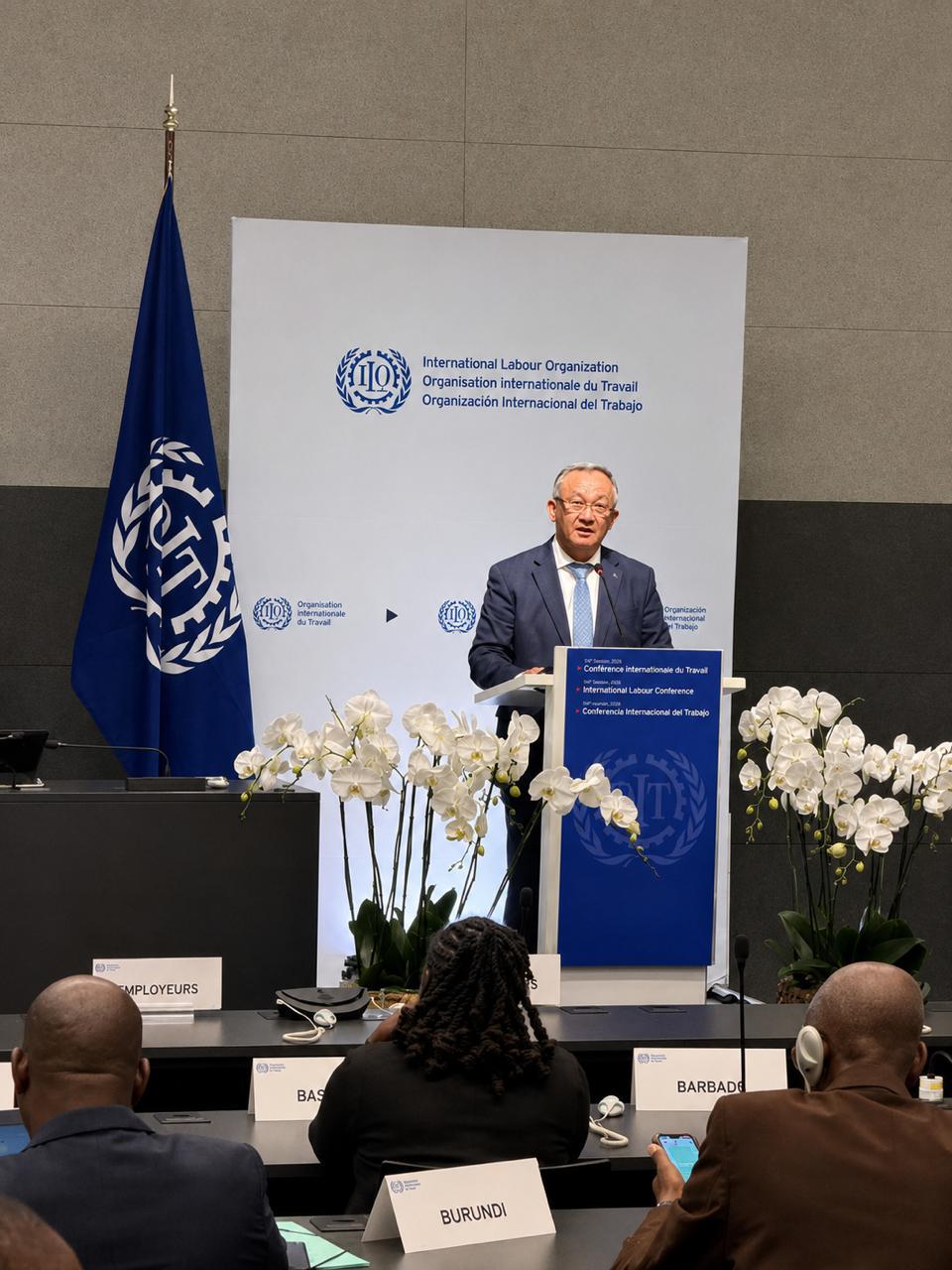
Addressing the participants, the Kazakh trade union leader emphasized that artificial intelligence is already having a significant impact on employment structures, work organization and the competencies required of workers, while also voicing the concerns expressed by employees across various enterprises.
“It is a great honour for me to represent the trade unions of Kazakhstan and speak on behalf of millions of workers in our region. The Director-General’s report raises an issue that concerns workers across the world today. The question is not about technology itself. It is about what the working person will become in the age of artificial intelligence.
Today, AI is already influencing work organization, employee evaluation and employment structures. Alongside new opportunities come new risks. Through our dialogue with workers at enterprises, we see that people are not afraid of technology itself. What concerns them is whether they will retain the right to shape their own working future. Will their experience still be valued tomorrow? Will machines make decisions about hiring and dismissal? Who will be responsible for algorithmic errors? Will new technologies deepen inequality?
That is why we fully support the Director-General’s main conclusion: technology must serve people, not the other way around. For Kazakhstan and the countries of Central Asia, this issue is particularly relevant.”
In his statement, the Chairman of the Federation of Trade Unions of Kazakhstan noted that digital transformation is of particular importance for the country.
“In Kazakhstan, 2026 has been declared the Year of Digitalization and Artificial Intelligence. The Law on Artificial Intelligence and the Digital Code have been adopted. The State is actively investing in the development of new technologies, and we support this course.
However, we firmly believe that the pace of technological implementation should not outstrip the creation of mechanisms to protect working people. New technologies can increase productivity, create jobs and unlock new opportunities for economic growth. Yet digitalization must not become a source of discrimination, opaque control or the erosion of labour rights.
No algorithm bears responsibility. Responsibility always rests with people. Therefore, trade unions cannot stand aside from digital transformation. In our Strategy until 2030, protecting workers’ rights in the digital era has been identified as one of our priorities.
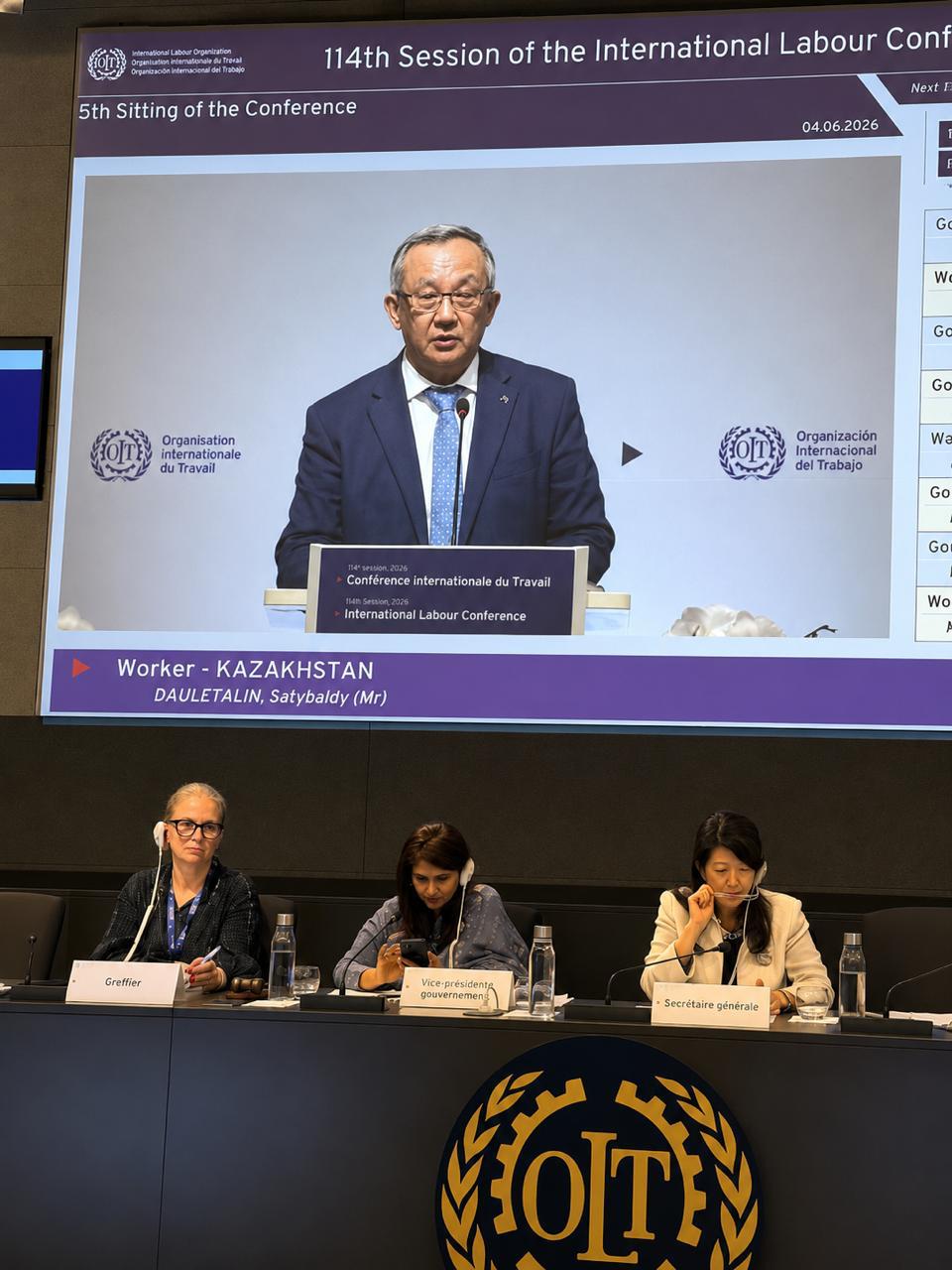
We have also developed standards for the protection of workers’ rights in the use of artificial intelligence. They are based on a simple principle: every worker should know when AI is being used in relation to them, understand how decisions are made, and have the right to challenge those decisions.
For us, this is not only a matter of regulation. It is a matter of trust. Without workers’ trust, no digital transformation can be sustainable.”
According to the head of the Kazakh delegation, the Federation of Trade Unions of Kazakhstan regards the protection of workers’ rights in the digital age as one of the key areas of its activities and of the further development of the social partnership system.
“Today, it is especially important that social dialogue accompanies technological change from the very beginning, rather than after problems have already emerged. A just digital transition is impossible without partnership between governments, employers and workers.
Governments create the modern legal framework. Employers ensure the responsible implementation of innovation and investment in human capital. Workers’ organizations help ensure that technological change strengthens decent work and social justice.”
Speaking from the podium of the International Labour Conference, Satybaldy Dauletalin outlined the key directions for joint action in the coming years.
“We support the ILO’s transformative agenda and believe that our common efforts should focus on three priorities.
First, workers must retain the right to human involvement in decision-making. Recruitment, dismissal, performance evaluation and disciplinary matters cannot be entirely delegated to algorithms.
.jpeg)
Second, investment in technology must go hand in hand with investment in people. Every worker should have opportunities for upskilling, reskilling and adaptation to changing labour market conditions.
Third, the world needs modern international rules governing the use of artificial intelligence in the world of work. We believe the time has come to launch a broad international discussion on global principles for AI in employment and on the development of modern international labour standards for the digital economy.
Fundamental workers’ rights must remain unchanged regardless of the form of employment, digital platform or algorithm used. The ILO possesses all the necessary capacities to shape such approaches at the global level. Trade unions of Kazakhstan and Central Asia are ready to participate actively in this work and contribute their practical experience.”
Concluding his speech, Satybaldy Dauletalin emphasized the central priority:
“Today, we are not choosing between technology and people. We are choosing what kind of development we want: one in which people adapt to algorithms, or one in which technology helps people realize their full potential.
History shows that the most sustainable solutions are those that keep people at the centre. Therefore, our shared task is to ensure that artificial intelligence serves working people, strengthens social justice and promotes decent work.
Our method is dialogue. Our strength is solidarity. Our choice is the working person.”
The work of the Conference continues across its three main venues — the Geneva International Conference Centre (CICG), the Palais des Nations and the ILO Headquarters — where delegates are discussing a broad range of issues related to decent work in the platform economy, equality and inclusion, the protection of fundamental workers’ rights, and the challenges of social justice in the era of rapidly advancing artificial intelligence.
FTURK Trade Union Communications Centre