

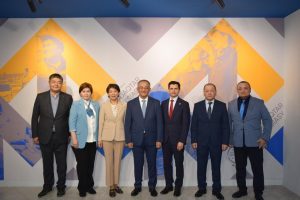
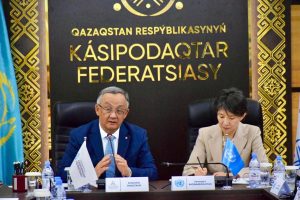
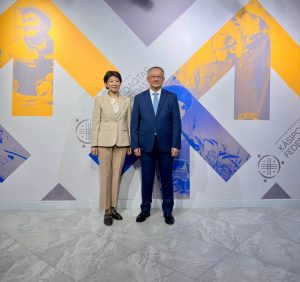
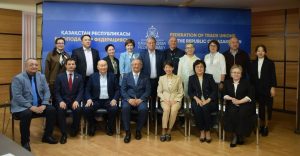
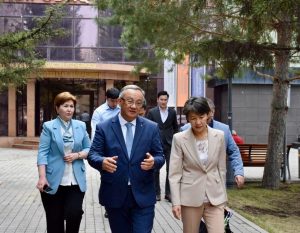
On Tuesday, April 7, Chairman of the Federation of Trade Unions of the Republic of Kazakhstan, Satybaldy Dauletalin, met with the UN Resident Coordinator in Kazakhstan, Sarangoo Radnaaragchaa.
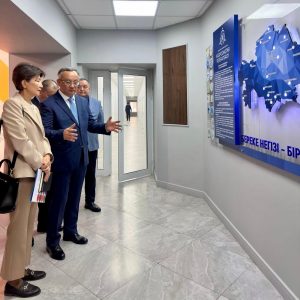
It should be noted that this is the first visit in the history of the Federation of Trade Unions of the Republic of Kazakhstan by a representative of the United Nations to the office of the national trade union center.
The parties discussed practical steps for implementing the Sustainable Development Goals (SDGs) at the national level through social dialogue, development of labor standards, and improvement of working conditions.
Opening the meeting, Chairman Satybaldy Dauletalin emphasized the importance of continuous information exchange between trade unions and international organizations.
The Kazakh trade union leader elaborated on the role of the trade union movement in monitoring labor processes and ensuring social protection of workers.
“The Federation of Trade Unions, as the largest public organization in the country, unites about two million workers and possesses a unique resource — a constant presence at the enterprise and regional levels, as well as active interaction with social partners at all levels. Our structure is not only regional and sectoral representations but also a full-fledged infrastructure covering the real sector of the economy. This provides us with a number of key practical opportunities,” noted Satybaldy Dauletalin.
According to him, trade union activities ensure several key areas of practical impact on the social and labor sphere.
“First, this is оперативная диагностика проблем на местах. Trade unions are the first to identify changes in wage levels, the spread of informal employment, deterioration of working conditions, and rising social tension. In essence, trade unions act as an early warning system with few equivalents in the country. Second, this is a direct communication channel with workers. Through trade union organizations, it is possible not only to inform but also to clearly explain reforms and demonstrate how they affect wages, working conditions, and safety — in general, people’s lives. This is especially important for successful implementation of reforms. Third, this is an effective mechanism for implementing standards. This involves not only discussion but also practical application through collective agreements. At most enterprises where trade unions operate (about 98%), collective agreements are in place — key documents regulating social and labor relations. They establish specific indicators: working conditions, minimum social guarantees, wage indexation mechanisms, and issues of training and professional development,” he said.
Satybaldy Dauletalin drew attention to the practical dimension of the SDGs through the concept of decent work.
“For us, the eighth Sustainable Development Goal — decent work and economic growth — is of particular importance. For most workers, it is not the wording of the goals that matters, but answers to concrete questions: whether there is stable employment, sufficient income to support a family, and safe working conditions. We proceed from a simple principle: a person should come to work healthy and return home alive and unharmed. At the same time, it should be noted that the SDGs remain insufficiently understood by a wide range of workers. Many perceive them as an expert agenda not directly related to everyday life. Therefore, our task is to translate these goals into clear and measurable indicators such as employment, income levels, and social protection,” emphasized the Chairman of the FTURK.
He noted that partnership with the International Labour Organization and the UN system makes it possible to transform global standards into measurable indicators for each worker.
“I would like to emphasize that the decent work agenda today organically unites the mandates of the UN system and the International Labour Organization. We positively assess Kazakhstan’s cooperation with the ILO and see significant potential for further expanding coordination with the UN system as a whole. It is especially important that we already observe changes in the approaches and formats of the UN system’s work, including the development of dialogue and new initiatives. This is confirmed by our meeting today. We view the UN not only as a coordinator of the global agenda but also as a key mechanism for building trust, promoting universal values, and adapting international standards to the national context. The unique legitimacy of the UN allows for balanced dialogue between the state, international institutions, and representatives of workers,” he noted.
The Chairman emphasized the need for a practical format of cooperation with the UN system.
“In this regard, we see several key areas for cooperation — translating the SDGs into concrete, measurable indicators understandable to people; developing dialogue platforms involving workers, employers, and regional structures; strengthening awareness-raising efforts to demonstrate the link between the global agenda and everyday life. The key idea of our interaction is to combine two resources: the potential of trade unions — people’s trust and presence in the real economy — and the capabilities of the UN system. Such a combination will make the global agenda truly work at the level of each individual,” he said.
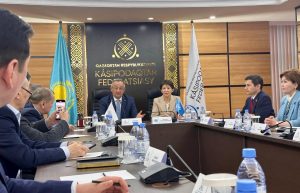
In turn, UN Resident Coordinator in Kazakhstan Sarangoo Radnaaragchaa presented an overview of the global sustainable development agenda, Kazakhstan’s role, and her vision of areas of cooperation with trade unions.
First of all, she spoke about the current state of SDG implementation globally and in Kazakhstan.
“As you know, the sustainable development agenda was adopted in 2015, and little time remains until 2030. If we look at global statistics and reporting, the picture is not very optimistic: only about 18% of the goals have been achieved worldwide. At the same time, the situation in Kazakhstan is significantly better — around 40% has been achieved. However, this does not mean we can stop. As a regional leader, Kazakhstan should set an example and accelerate progress in the remaining areas,” she emphasized.
She highlighted the importance of involving all social institutions, including trade unions, in achieving the SDGs.
“Trade unions are one of our most important partners. Sometimes the SDGs are perceived as something distant or belonging only to the UN, but in reality, they concern everyone. It is important that society understands how they are connected to everyday life and that their achievement directly affects quality of life,” she noted.
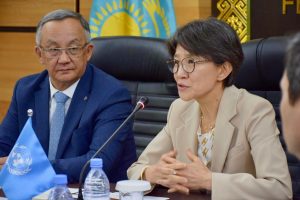
She also addressed Kazakhstan’s international engagement and its position in the global agenda.
“Kazakhstan has already demonstrated strong commitment to this agenda. Within the UN, there is a mechanism of voluntary national reviews, and Kazakhstan is among the few countries that have presented such a review for the third time. This indicates a high level of international engagement,” she said.
Regarding the content of the SDGs, the UN representative emphasized their systemic nature.
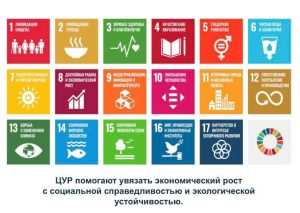
“It is important to consider all 17 SDGs as a whole. They are interconnected: progress in one area affects others. For example, economic development is impossible without quality education, healthcare, equality, and effective institutions. Similarly, without addressing environmental issues, sustainable social development cannot be ensured,” she stressed.
Speaking about Kazakhstan, she noted a strong institutional base alongside remaining challenges.
“In Kazakhstan, a solid institutional framework for advancing the SDGs has been established: there is a national plan, a system of indicators, coordination mechanisms, and parliamentary oversight. However, challenges remain in specific areas — especially gender equality, healthcare, environmental sustainability, and infrastructure,” she said.
She emphasized the importance of regional-level implementation.
“Localization of the SDGs is key. Progress is determined not only nationally but also regionally. This is where trade unions play an important role by conveying real issues and participating in their resolution,” she noted.
In the area of socio-economic development, she provided specific data.
“Kazakhstan’s economy is growing — GDP increased by 6.5% in 2025, and unemployment remains relatively low. However, disparities persist, particularly between men and women and between urban and rural areas. Inflation also reduces real incomes,” she stated.
She outlined priority areas relevant to trade unions and social policy.
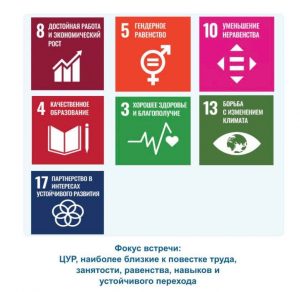
“Particular attention should be paid to SDG 8 (decent work), SDG 5 (gender equality), SDG 10 (reduced inequalities), SDG 4 (quality education), and SDG 3 (health). Cross-cutting priorities include climate action (SDG 13) and partnerships (SDG 17),” she said.
A separate part of her speech focused on climate policy and a just transition.
“The climate agenda requires a just transition to a ‘green’ economy. This is especially relevant for Kazakhstan given the high share of emissions in the energy sector. The transition must consider the interests of workers and regions and ensure social stability,” she emphasized.
She also outlined the UN’s approach in Kazakhstan.
“UN support in Kazakhstan is mainly focused on expert, institutional, and policy assistance. We act as a strategic partner and create platforms for dialogue between the government, employers, and trade unions. The UN has already supported labor inspection modernization, occupational safety development, and promotion of international standards, including ILO Convention No. 190. There are 27 UN agencies operating in Kazakhstan, and their combined work contributes to achieving the SDGs. Cooperation with trade unions is essential because you work on the ground and best understand people’s needs. The SDGs only make sense when they are reflected in everyday life,” she noted.
The UN Resident Coordinator expressed readiness to further strengthen cooperation with the FTURK.
“We already have a solid foundation for cooperation and are ready to expand it, including in gender equality, reducing inequalities, and climate issues. We are open to dialogue and joint work,” she concluded.
Summing up the meeting, Chairman Satybaldy Dauletalin confirmed readiness for joint work to achieve national and global goals.
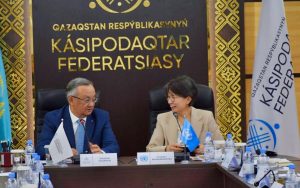
“Why is it important for us to act systematically? Because we are present everywhere, and this is our key advantage. We are talking not only about SDG 8, but also about goals 5, 10, 4, 3, and 17. From an informational perspective, it is important for us to define specific indicators that will enable effective action. We are ready to regularly provide updates on progress. Through joint work, we will be able to define all the details more clearly,” he said.
He emphasized the strategic orientation of joint efforts.
“We intend to move forward together and improve people’s well-being, including through achieving the Sustainable Development Goals. We are also ready to expand cooperation with other agencies and partners, building systematic, constructive, and goal-oriented work,” concluded the Chairman of the Federation of Trade Unions of the Republic of Kazakhstan.
Center for Trade Union Communications of the FTURK