

As part of a working visit to the Turkestan region, the Chairman of the Federation of Trade Unions of the Republic of Kazakhstan visited the “Uly Dala Eli” Cultural Center and held a series of meetings with members of primary and sectoral trade unions in the region.
The “Uly Dala Eli” Center, opened in 2020, features 9 exhibition halls: “Metallurgy of the Great Steppe,” “Equestrian Culture of the Great Steppe,” “Treasures of the Great Steppe,” “Kazakhstan – the Cradle of the Turkic World,” “Kazakh Khanate,” “Urban Culture of the Great Steppe,” “The First President of Kazakhstan,” “Future Kazakhstan,” and “Kazakhstan – the Homeland of Apples and Tulips.” The total number of exhibits in the center is 5,129.
According to the Director of the Center, Gulzhanat Dyussenbayeva, the staff consists of 62 employees, all of whom are members of the trade union organization.
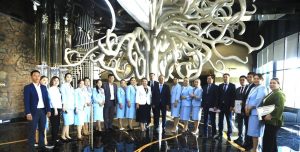
After ознакомившись with the activities of the center, Chairman of the Federation of Trade Unions of the Republic of Kazakhstan, Satybaldy Dauletalin, emphasized the importance of preserving cultural and spiritual heritage.
“This center is a true place of education, a source of knowledge for everyone who comes here. The very name ‘Uly Dala’ speaks volumes. You continue the traditions of our ancestors who lived in the vast expanses of the Kazakh steppe—their culture, character, and spirit—and you convey all of this to the people, to the youth. Unfortunately, the work of museum employees and public sector workers often goes unnoticed. Therefore, it is important for us to create decent working conditions and improve their quality—this is one of the priority tasks of the Federation of Trade Unions. This concerns wages as well as other social issues. Today it is important to unite, to know and defend your rights, and to move forward together. Through unity, cooperation, and mutual support, we can improve the situation of cultural workers,” emphasized Satybaldy Dauletalin.
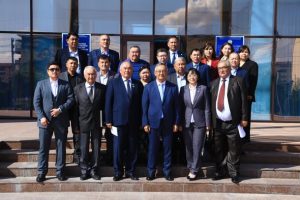
The working visit program continued with a meeting with trade union activists of the Turkestan region.
According to the Chairman of the Trade Union Center of the Turkestan region, Berdigali Omirali, the territorial association of trade unions currently coordinates the activities of 6 branches of sectoral trade unions and 7 local trade union organizations, as well as 1,281 primary trade union organizations, with a total membership of about 65,000 people.
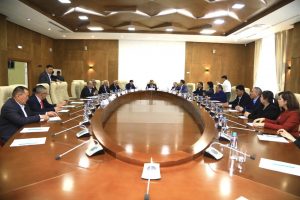
During the dialogue, issues of developing social partnership, participation of trade unions in the socio-political life of the region, monitoring compliance with workers’ interests—including occupational safety monitoring and implementation of social guarantees—were discussed.
“In 2025, 40 workplace accidents were registered in the Turkestan region. As a result, 46 people were injured, 8 of which resulted in fatalities. Among enterprises where trade union organizations affiliated with the Federation of Trade Unions operate, 10 cases were recorded, with 12 people injured. The level of occupational injuries decreased by 4.8% compared to 2024,” the Chairman of the Trade Union Center reported.
According to him, in 2025, 59 training seminars were held for trade union members in the region, with more than 3,000 participants.
Special attention is paid to protecting workers’ rights through the activities of the FTURK Legal Clinic branch.
“The trade union legal clinic of the Turkestan region provides legal support not only to union members but to all applicants. According to the results of 2025, legal assistance was provided to 331 people, of whom 298 were union members. All cases were resolved positively,” said Berdigali Omirali.
During the meeting, Chairman of the Federation of Trade Unions of the Republic of Kazakhstan Satybaldy Dauletalin emphasized the importance of trade union activities at the local level.
“Currently, we are visiting the regions. Upon arriving in the Turkestan region, I personally meet with workers. We discuss the state of social and labor relations regulation and the pressing issues faced by trade union members. I consider it necessary, within the framework of implementing the new FTURK Strategy, to regularly exchange views within our Federation and with social partners. Only in this way can we effectively influence decisions that affect people’s lives,” emphasized the Chairman.
During the meeting, Satybaldy Dauletalin also reminded colleagues of changes in national legislation in connection with the adoption of the new Constitution.
“Together, we developed proposals for the new Constitution, and today the Basic Law enshrines not only duties and rights but also the value of the working person. The state assumes responsibility for creating conditions in which workers can realize their potential, feel protected, and be confident in fair wages and safe working conditions. The state undertakes to create all necessary conditions—from labor safety to fair pay and opportunities for professional growth. This is a fundamentally new approach that directly affects the quality of life of workers. Training, professional development, and the application of international partners’ experience must become part of our daily practice,” he noted.
Turning to legislative initiatives, the Chairman highlighted the special role of a new institution—the People’s Council.
“The Parliament is considering a number of constitutional laws, including the establishment of the People’s Council of Kazakhstan. Representatives of public associations will also participate in its work. The Federation of Trade Unions intends to become part of the People’s Council. For us, this is a unique opportunity to develop laws aimed at improving working conditions, protecting workers’ rights, and developing social partnership. A trade union should not only state problems—it must seek solutions together with employers and government bodies,” said the Chairman of the FTURK.
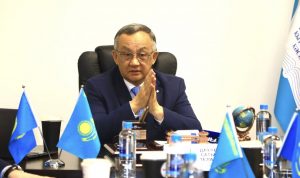
Speaking about the tasks facing the Federation of Trade Unions and its member organizations, Satybaldy Dauletalin noted that trade unions must participate in the implementation of the provisions of ILO Convention No. 131, ratified at the end of last year, and continue the digital transformation of trade union activities in accordance with the adopted concept.
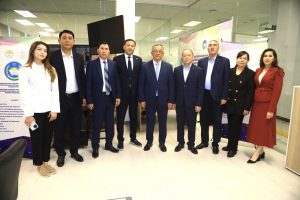
The importance of continuing the implementation of the new Strategy of the Federation of Trade Unions for 2025–2030 was also emphasized during a meeting with the staff of the regional branch of the education, science, and higher education trade union in the Turkestan region.
Satybaldy Dauletalin highlighted the significant contribution of the sectoral education trade union to the development of the country’s trade union movement.
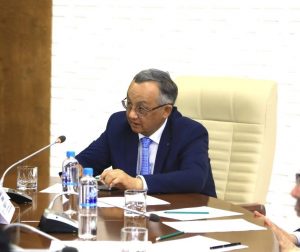
“The education trade union is the largest within the FTURK, accounting for about 40% of our members—around 600,000 people. Its contribution cannot be overstated. Every day, issues of wages, protection of teachers’ rights, and organization of the educational process are addressed here. Work in the region and in primary trade union organizations is carried out at a proper level. We must not deviate from this path—we need to give momentum, support initiatives, and train and develop personnel,” urged Chairman of the Federation of Trade Unions of the Republic of Kazakhstan Satybaldy Dauletalin.
Center for Trade Union Communications of the FTURK