

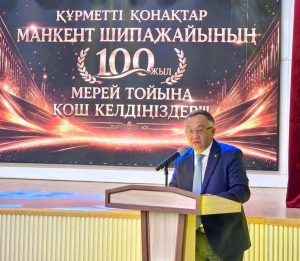
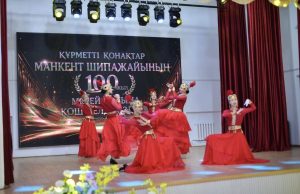
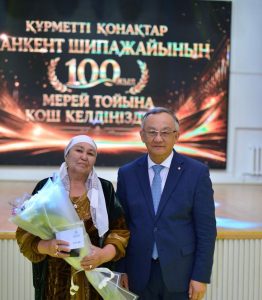
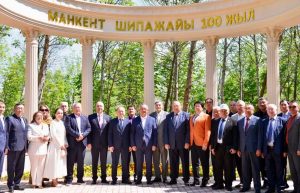
On Friday, April 10, as part of a working visit to the Turkestan region, Chairman of the Federation of Trade Unions of the Republic of Kazakhstan, Satybaldy Dauletalin, took part in a ceremonial event dedicated to the 100th anniversary of the “Mankent” sanatorium.
The “Mankent” sanatorium is one of the oldest trade union health resorts in Kazakhstan, with its history dating back to the 1920s. Over the century, the institution has evolved from a small rest house into a modern multidisciplinary complex, while preserving its core mission – improving health and supporting workers. During various historical periods, the sanatorium fulfilled important social functions, including operating as a hospital during wartime, and held leading positions among health resorts at the союз level.
Participants of the event included representatives of the trade union movement, social partners, veterans, and employees of the health resort.
Welcoming the participants, Chairman of the Federation of Trade Unions of the Republic of Kazakhstan, Satybaldy Dauletalin, noted the historical significance of the sanatorium and its contribution to the development of the national worker health system, emphasizing continuity of generations and the institution’s enduring social mission.
“100 years is the chronicle of an entire era. It is a path of labor, many trials and great achievements, and most importantly – a path of endless care for people. This is a great history in which the destinies of those who founded the ‘Mankent’ sanatorium and thousands of people who enhanced its glory have intertwined. In all times, ‘Mankent’ has remained true to its noble purpose. It is service to the people, preservation of workers’ health, and giving them life energy,” noted Satybaldy Dauletalin.
The Chairman of the FTURK expressed special gratitude to veterans who contributed to the development of the sanatorium and the formation of its professional traditions.
“You are the pride and backbone not only of the sanatorium but of the entire trade union movement. Your work is a feat accomplished without loud words but with great dedication. You built buildings, developed the medical base, created an atmosphere of trust and care, and formed traditions that are still alive today. It is thanks to you that ‘Mankent’ has become what it is today – a symbol of quality, reliability, and professionalism. We bow to you and express our sincere gratitude,” said Satybaldy Dauletalin.
At the same time, the Chairman noted the contribution of the sanatorium staff to the development of the healthcare system, emphasizing their high level of professionalism.
“Your profession is a calling. Every day you stand guard over people’s health. You do not just treat – you restore the joy of life, help people regain strength, confidence, and inner harmony. The high level of medical services, the introduction of modern diagnostic and treatment methods, and attentive care for each guest make ‘Mankent’ in demand and respected not only in Kazakhstan but also beyond its borders. Your work combines professionalism, humanity, and great generosity of spirit. For this, you deserve special words of gratitude,” the Chairman noted.
Satybaldy Dauletalin emphasized the priority of caring for workers’ health for the trade union movement.
“The Federation of Trade Unions of the Republic of Kazakhstan has always paid and will continue to pay primary attention to improving workers’ health. This is not just a social task – it is a strategic priority. Behind every worker stands a family, the future, and the development of the country. And it is such health resorts as ‘Mankent’ that become the most important link in the system of preserving the nation’s health,” said the Chairman.
Speaking about future tasks, the Chairman of the FTURK noted the importance of modernizing the sanatorium-resort system and improving service quality.
“The Federation of Trade Unions and the sanatorium staff face large-scale and ambitious tasks: further modernization of the sanatorium-resort base, renewal of medical equipment, introduction of innovative treatment and rehabilitation methods; expanding access to sanatorium treatment for workers of various industries and their families; development of international cooperation, strengthening positions in the health tourism market and attracting foreign guests; improving service quality and standards in line with the best global practices; implementation of environmentally sustainable and energy-efficient solutions, development of ‘green technologies’; support and development of human resources, creating conditions for the professional growth of medical staff. I am confident that, relying on its rich heritage, the professionalism of its team, and the support of the Federation of Trade Unions, the ‘Mankent’ sanatorium will continue to strengthen its position as a flagship of health improvement and social protection of workers,” emphasized Satybaldy Dauletalin.
In turn, General Director of JSC “Sanatorium ‘Mankent’” Khamrakul Kurganov noted that today the health resort is a modern complex that annually receives thousands of guests, providing comprehensive treatment and health recovery. He emphasized the role of the team and veterans, highlighting the human factor as a key resource for sustainable development.
“We sincerely thank the veterans who stood at the origins and the current team, who ensure a high level of services every day. It is thanks to their work that the sanatorium holds a достойное место among the best health resorts in the country,” he stressed.
Among the priorities for further development, he outlined plans to continue infrastructure modernization, introduce modern treatment technologies, improve service quality, and strengthen positions in the health tourism market.
During the ceremonial event, author of the book on the sanatorium’s history, journalist Diana Idris, delivered a speech, noting that through archival research she managed to restore a comprehensive picture of the sanatorium’s development and show the scale of work behind its success.
Veteran of the trade union movement Anatoly Zelenkov, former Deputy Chairman of the FTURK, shared insights on the stages of formation and preservation of the sanatorium-resort system of trade unions during periods of socio-economic transformation.
“There were times when the resort system practically lost its financial support. At that moment, the main task was to preserve what existed. And the first generation of leaders coped with this task. These are the people who preserved sanatoriums such as ‘Shchuchinsky’, ‘Moyildy’, ‘Koktem’ and many others. It is thanks to them that the system survived at all. Today, a new generation of leaders has come, who not only preserved but also began restoring and developing the system,” the veteran said.
The historical significance of the anniversary and the special role of the sanatorium in the life of the region were also emphasized by Akim of Sairam district of the Turkestan region, Madiyar Orazaliyev, who noted that the “Mankent” sanatorium is known not only in the country but also beyond its borders.
The symbolic nature of the centennial anniversary was also highlighted by Chairman of the Trade Union Center of the Turkestan region, Omirali Berdigali.
“The ‘Mankent’ sanatorium can rightfully be called the shanyrak of the region’s trade union movement. It is a place where collective spirit is formed, unity is strengthened, and conditions are created for the health improvement of every worker,” he said.
In turn, Chairman of the Trade Union Center of Shymkent, Bauyrzhan Alteyev, noted the special atmosphere of the sanatorium and its strong reputation as one of the key health centers in the region.
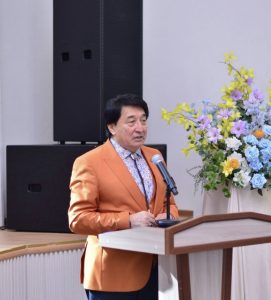
“I would like to speak not about the entire century-long history, but about the period closer to me – the last 30–35 years of the sanatorium’s development. It is especially important to highlight the contribution of Azat Kurganovich Sadybaldiev. Despite all difficulties, he worked under any conditions and made a huge contribution to the establishment, growth, and sustainable development of the sanatorium,” he said.
Public figure Auelbek Turganbekov also emphasized the high status and popularity of the sanatorium.
“A person who comes here once usually returns again because they feel the results, care, and atmosphere of trust. I am confident that the sanatorium has a great future. Being part of such an institution is a great pride,” he said.
The ceremonial program continued with awarding veterans, employees, and trade union activists of the sanatorium, as well as cultural and sports events.
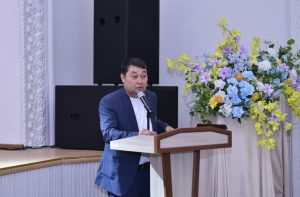
In recognition of contributions to the development of the institution and strengthening its material and technical base, an alley named after Azat Satibaldiev – the former head of the sanatorium – was opened.
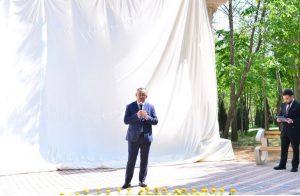
A ceremonial unveiling of a stele also took place. The symbolism of its meaning was noted by the Chairman of the Federation of Trade Unions of the Republic of Kazakhstan, Satybaldy Dauletalin.
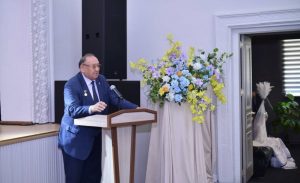
“The stele unveiled as part of the anniversary consists of seven pillars. This number has special significance and symbolizes key values – stability, continuity, respect for traditions, responsibility, and development. Each element reflects the work of people employed at the sanatorium. This structure reflects the history and development of the sanatorium and may become part of its cultural space, reminding of its formation and growth,” he concluded.
For reference: The “Mankent” sanatorium is located 6.5 km from the railway station of the same name, away from major industrial facilities and highways. A park with coniferous and fruit trees is laid out on its territory, and the air is rich in phytoncides. Year-round facilities include an indoor swimming pool with hydromassage, infrared sauna, gym, billiards, and excursion bureau services.
The basis of treatment in this multidisciplinary sanatorium is climatotherapy and mineral water from the Mankent deposit, extracted from a depth of 1,210 meters. It is low-mineralized, classified as weakly alkaline sulfate-chloride-sodium water. It is used both for drinking therapy and balneotherapy. It is effective in treating gastrointestinal diseases, urological and gynecological conditions, polyarthritis, osteochondrosis, spondyloarthritis, and radiculitis.
Center for Trade Union Communications of the FTURK